AORTIC VALVE
TAVR
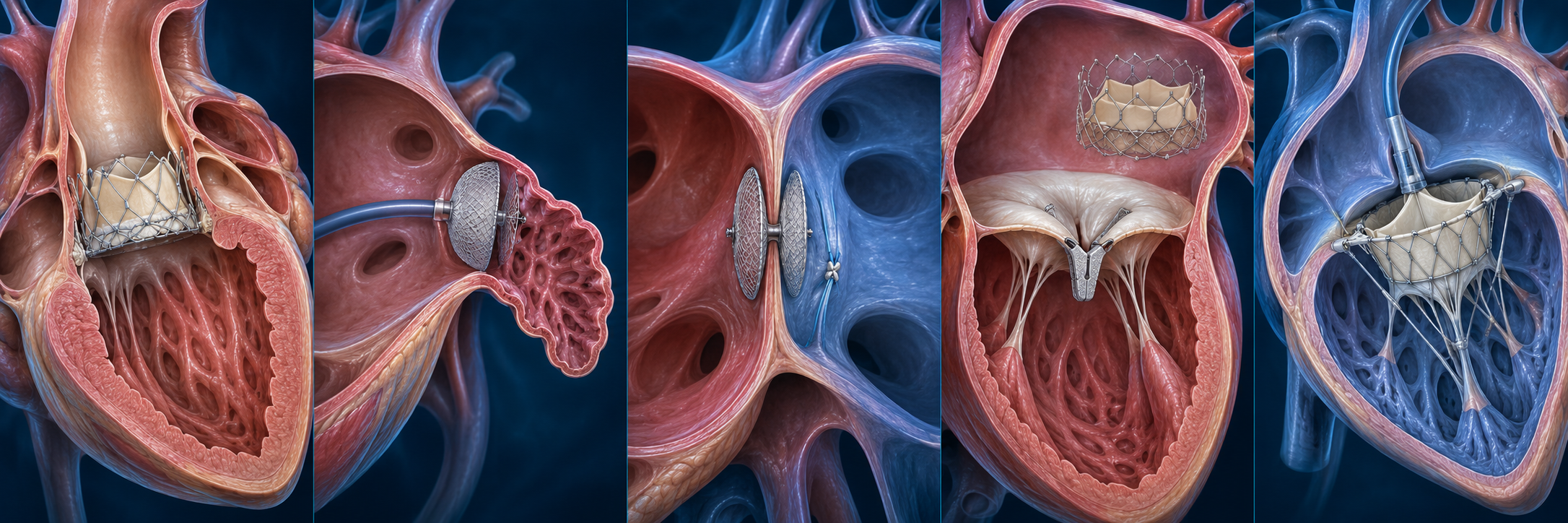
A bioprosthetic valve frame positioned within the native aortic annulus.
Physician-informed research and development focused on structural heart valve technologies, catheter-based therapies, and elegant solutions for complex anatomy.
Explore the target anatomy and the general form of catheter-based technologies used across contemporary structural heart care.
A bioprosthetic valve frame positioned within the native aortic annulus.
A conformable occlusion implant seated at the appendage ostium.
Disc-based occlusion and tissue-preserving suture closure concepts.
Leaflet approximation and transcatheter replacement concepts for mitral disease.
Catheter-based repair and replacement concepts designed for right-heart anatomy.
Educational illustrations are generic and are not depictions of any specific manufacturer’s product. Device selection and treatment decisions require evaluation by a qualified heart team.
Our focus spans valve replacement, repair, occlusion, and closure systems—grounded in anatomy, procedural reality, and meaningful clinical need.
Concepts for valve performance, anchoring, sealing, commissural alignment, coronary access, delivery systems, and lifetime management.
Approaches to adaptable fixation, complete sealing, lower device footprint, procedural simplicity, and anatomy-responsive closure.
Transcatheter and suture-based concepts for ASD and PFO closure with attention to tissue preservation and future access.
Replacement and repair concepts addressing annular complexity, LVOT interaction, sealing, anchoring, and deliverability.
Systems designed around large, dynamic anatomy, variable leaflet geometry, right-heart physiology, and venous access.
A disciplined pathway links clinical insight to engineering development while keeping usability, anatomy, and safety at the center.
Identify a consequential clinical or procedural limitation worth solving.
Translate imaging, biomechanics, and procedural constraints into requirements.
Develop concepts, assess failure modes, and refine through structured testing.
Prepare for verification, preclinical evaluation, regulatory strategy, and translation.
Delivery, visualization, deployment, repositioning, retrieval, and workflow should be designed as one integrated clinical experience—not addressed after the device is built.
Structural Heart Innovations brings a procedural lens to early-stage device strategy, concept definition, and development planning.
Procedural pain points, patient selection gaps, anatomical limitations, workflow friction, and complication-driven opportunities.
Physician-led product requirements, delivery concepts, deployment sequences, and usability priorities.
CT, echocardiographic, fluoroscopic, and access considerations integrated into device architecture.
Bench-test logic, preclinical questions, risk framing, clinical endpoints, and development milestones.
Engagement with engineers, inventors, research partners, manufacturers, and development teams.
Dr. Raj Marok is a board-certified interventional and structural cardiologist with more than a decade of experience in complex coronary intervention, transcatheter valve therapy, left atrial appendage closure, and congenital structural interventions. A Clovis native, he returned to California’s Central Valley after serving as Medical Director of Structural Heart Disease and Co-Director of a complex high-risk PCI and CTO program in West Michigan.
He previously served as an Associate Professor of Medicine at Michigan State University College of Human Medicine and as core faculty for an interventional cardiology fellowship. His advanced interventional training included structural heart, complex coronary, and vascular intervention at Columbia University Medical Center and NewYork-Presbyterian Hospital.
Dr. Marok’s research and development interests center on left atrial appendage closure, transcatheter valve technologies, imaging-guided intervention, and quality improvement. He has served as a principal investigator and sub-investigator in multicenter clinical trials and participated in the world’s first preclinical implant of the WATCHMAN FLX Pro device as part of its FDA approval program.
His work is driven by a simple premise: device design should begin with anatomy, workflow, and the unmet needs encountered in real patient care.
If you are interested in learning about our research focus, sharing a patient perspective, or receiving future updates, send us a brief message.
We are developing and evaluating new ideas at the intersection of structural heart medicine, device engineering, and procedural innovation.